Different Representations
In middle school, I got stuck on algebra.
Specifically, expressions like (x + y)2. I was wrong, but at the time, I naively thought it became x2 + y2.
To solve this, we were taught FOIL, an algorithm, for expanding (x + y)2. It was simple enough. But I was never convinced that the exponent didn’t distribute to both terms, like multiplication does. I just could not understand why it didn’t become x2 + y2.
And because I couldn’t intuitively grasp why it didn’t distribute, I stubbornly resisted it, and it cost me my 7th grade summer. At the end of the school year, I was presented with a dilemma: move down to a slower math track the following year, or take a summer bridge class to stay on the same path as my friends. I chose summer school. Eventually, I accepted the rule and passed, but it never really sat right with me.
It wasn’t until years later that it finally clicked for me. While watching an old MIT OCW lecture1, I came across an explanation that finally made sense. An explanation that I could accept.
The professor didn’t write out long equations or do rote calculations. He just drew a simple square on the chalkboard, splitting the top and side lengths into two segments: x and y.
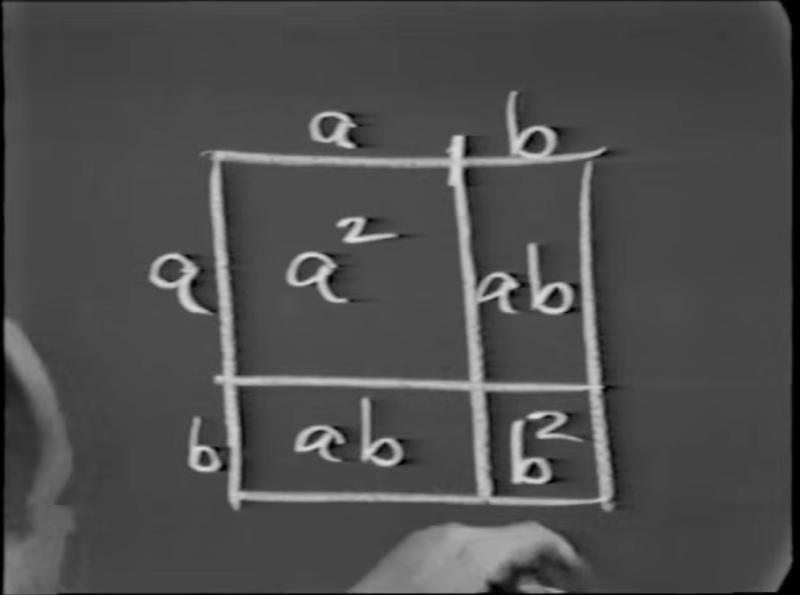
It clicked. The geometric explanation made sense. In three seconds, a concept that cost me an entire summer became obvious.
That revelation stayed with me. It made me realize that my problem in middle school wasn’t mathematical ability, but rather that the analytic form felt insufficient. I had only been shown one representation of it, but when it was framed differently, it made perfect sense. That sparked a question that changed how I reason about everything: What changes when you change how something is represented?
In Driving
Google Maps and Apple Maps usually give instructions in distance: “In 2 miles, use the right two lanes to take exit 14.”
The problem is that “2 miles” is hard to grasp intuitively, especially when driving at high speeds. I know what 2 miles is 5,280 ft x 2. But on the highway, having a grasp for spatial distance is hard, to say the least, whereas in residential areas you can tell when you’re approaching an intersection. As a result, there’s been times when I have missed highway exits because I decided to change lanes too late.
A trick I’ve found is to convert distance into time. If I have roughly 2 minutes before I need to take an exit rather than “2 miles,” I know I can stay in my lane for now, but will need to start merging soon. Minutes and seconds are much easier to grasp. If I’m told to stay on the same highway for 20 minutes, I know I can relax and focus on driving instead of having to worry about a lane change.
Two numbers I keep in mind are 60 seconds and 45 seconds. Driving at 60 miles per hour means 1 mile a minute, and 80 mph means a mile every 45 seconds. So 2 miles becomes 2 minutes at 60 mph and 90 seconds at 80 mph. I like to use the shorter estimate for some buffer, but these are rules of thumbs I use.
Now, 90 seconds is something my brain can easily understand while driving.
It’s surprising to me that navigation apps like Google Maps or Apple Maps don’t offer a “time-to-decision” toggle instead of raw mileage. Changing the unit can change how your brain processes the choice.
Visualizing life
Changing representations is also helpful for less tangible ideas. Seconds and minutes are easy to reason about, but how about years and decades?
In The Tail End, Tim Urban points out how the default way we think about time is probably wrong or lacking. It’s a short read and I highly recommend it.
He starts by breaking human life down into years, then months, and finally weeks. Looking at that grid of tiny boxes was sobering.
In short, if the average life expectancy is 90, and If you are in your 30s and your parents are in their mid 60s, then it’s natural to assume that there’s 30 years left. Well that’s a long time right? But what if you only see them once a year, every Christmas, that’s only 30 more visits, potentially 15 if you split it with your inlaws. 15 times is more concrete and tangible than 30 years.
Play with the representation
It’s a natural tendency, once we’ve been trained to think a certain way, to continue thinking that way. I wrote this to serve as a reminder to think differently – just to see if anything changes.
Swap symbols for pictures. Swap distance for time. Swap continuous years for a stack of countdown tokens. You might be surprised at how quickly a different representation provides more affordances.